


7 Ways Early Childhood Education Builds Social Skills

Last Updated: November 2, 2026
Quick Summary
Yes, early childhood education improves social skills, mainly through repeated practice with peers, guided conflict resolution, and emotional vocabulary. Children build sharing, turn-taking, and empathy through daily group routines rather than single lessons. A classroom is not required, but it makes that practice more frequent and varied.
Repeated peer contact teaches children how friendships form and how to recover after a fight.
Teachers ask guiding questions so children learn to find their own words during conflicts.
Children who can name a feeling like upset are better able to manage it without hitting.
Sharing is taught in small steps, such as handing over one crayon before trading a toy.
Playdates and neighborhood play can also build social skills without preschool.
Table of Contents
Does Early Childhood Education Improve Social Skills?
Yes, early childhood education does improve social skills, and the gains show up in everyday play long before kindergarten. Preschool gives children a steady group of peers, a predictable routine, and adults who guide them through conflict.
Early childhood education is structured learning for children from infancy through age five, with a focus on language, emotion, and play. Its social benefits come from repeated practice with other children, not from any single lesson.
Parents often ask whether their child really needs a classroom to learn how to get along. The honest answer is that a classroom is not required, but it makes practice more frequent and more varied. Below, we explain how that works and what it looks like in practice.
A group setting offers daily chances to share, wait, and resolve disagreements.
Teachers model language for feelings, such as "You are frustrated because you wanted the truck."
Routines teach children what to expect, which lowers stress during transitions.
The Mechanisms That Connect Preschool to Social Growth
Preschool builds social skills through three main mechanisms: repeated peer contact, guided conflict resolution, and emotional vocabulary. Read how individualized learning for preschool children tailors this growth to each child. Each one gives children a different kind of practice.
Repeated peer contact matters most. A child who sees the same classmates every day learns how friendships form, how to take turns, and how to recover after a fight. Consistency is what turns a one-time lesson into a habit.
Guided conflict resolution is the second mechanism. Teachers do not solve every problem for children. Instead, they ask questions like "What can you say to your friend?" so children learn to find their own words.
Emotional vocabulary is the third. Children who can name a feeling are better able to manage it. A simple word like "upset" gives a child a way to express anger without hitting.
Staff are trained and certified in CPR, First Aid, Communicable Diseases, and Child Abuse Prevention.
Preschool Social Skills Children Actually Develop
Children in preschool typically build a specific set of social skills. These skills are practical, observable, and useful at home and in kindergarten.
Here are the skills teachers see most often:
Sharing and turn-taking: Children learn to wait for a toy and hand it over.
Asking for help: Children learn to use words instead of grabbing.
Joining play: Children learn to ask "Can I play?" and watch how a group responds.
Managing frustration: Children learn to pause, breathe, and try again.
Showing empathy: Children begin to notice when a friend is sad and offer comfort.
Each of these skills grows through repetition. A child rarely masters turn-taking after one try, but after weeks of practice the behavior becomes automatic. Parents who want to reinforce these skills at home can praise specific actions, such as "You waited for your turn, and that was kind."
Teachers see a consistent set of social skills develop in preschool, and each one grows through repetition.
Skill | What it looks like | How it grows |
Sharing and turn-taking | Waiting for a toy and handing it over | Repeated practice over weeks |
Asking for help | Using words instead of grabbing | Repetition until automatic |
Joining play | Asking "Can I play?" and watching the group | Observing how groups respond |
Managing frustration | Pausing, breathing, and trying again | Practice with guided support |
Showing empathy | Noticing a sad friend and offering comfort | Gradual awareness over time |
Social Skills Activities for Preschoolers in Practice
The best social skills activities for preschoolers are simple, playful, and repeated often. They do not need special equipment.

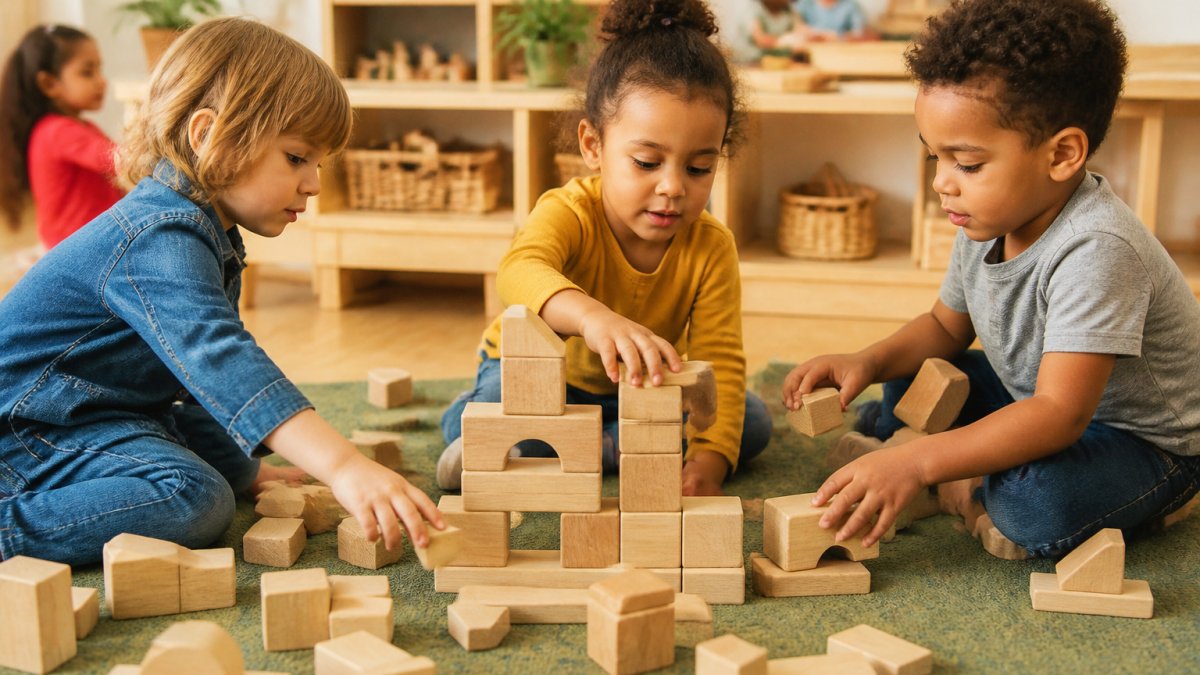
Four preschoolers sitting together at a low table in a bright classroom, taking turns with wooden blocks while a teacher kneels nearby smiling, shows how small groups build cooperation through everyday play. Explore hands-on learning ideas for toddlers for more activities like these.
Try these activities at home or in the classroom:
Taking turns with a timer: Set a two-minute timer and pass a toy each time it rings.
Feelings charades: Children act out an emotion while others guess it and talk about what helps.
Group building: Several children build one tower with blocks and each adds one piece in order.
Story retelling: Children take turns adding one sentence to a shared story.
Start with one activity per week. Consistency matters more than variety, and children tend to ask for favorites again and again.
How Preschool Teaches Sharing and Cooperation
Preschool teaches sharing and cooperation through structured group tasks and clear expectations. See how a collegiate-based preschool curriculum organizes group learning around these goals. Teachers set up shared projects, such as painting a mural, where every child must contribute.
Sharing is taught in small steps. A teacher might first ask a child to hand over one crayon, then later to trade a toy for a turn. Each step is a little harder, and each success builds confidence.
Cooperation grows when children work toward a goal together. A group that builds a bridge out of blocks learns quickly that one child cannot finish alone.
Can Children Build Social Skills Without Preschool?
Yes, children can build social skills without preschool, mainly through playdates, family gatherings, and neighborhood play. Compare outcomes in academic preschools and school readiness before deciding which path fits your family. Preschool is one path among several, not the only one.
The difference is consistency and variety. Home and neighborhood play often involves the same few children and familiar adults. Preschool adds a wider mix of personalities and a trained adult guiding interactions.
Many families combine both. A child who attends preschool three days a week can practice new skills at school and then use them with siblings or neighbors on the other days.
Building a Parent-Teacher Partnership for Social Development at Premier Kids Academy
Social skills grow fastest when parents and teachers use the same language and expectations. Ask your child's teacher which skills they are working on this month, then reinforce those same skills at home.
For a fuller look at what typical growth looks like by age, see the complete guide to social emotional development milestones by age.
Research from the [National Association for the Education of Young Children | naeyc.org] supports the view that high-quality early learning builds social competence. Parents can also review guidance from the [Centers for Disease Control and Prevention | cdc.gov] on early childhood development milestones.
Frequently Asked Questions
Does early childhood education improve children's social skills?
Research on early childhood programs generally links quality preschool with gains in peer interaction, cooperation and emotional regulation, particularly when teachers deliberately coach social behavior. Children practice these skills daily with peers of similar age, receive guidance when conflicts arise, and gain experience working in groups. The effect depends on program quality, group size, and teacher training, so parents should look at how staff handle everyday interactions rather than relying on a general promise of improvement.
How does preschool help children learn to share and take turns?
Preschool creates repeated, low-stakes situations where sharing is required, such as limited toys, shared art supplies, and group games with rotating turns. Teachers model the language children need, like asking to join or saying when it is their turn, and step in to help children wait. Over time, children learn that cooperation gets them access to materials and play partners, which makes sharing a practical habit rather than a rule they only follow when watched.
What social skills should a preschooler develop?
Most preschoolers should be building the ability to take turns, share materials, follow simple group routines, express feelings with words, recognize how others feel, and ask a peer or adult for help. Some children are still developing these skills at age four or five, which is normal. Parents concerned about persistent difficulty with peers should raise the question with the child's pediatrician or preschool teacher for an individual assessment.
How can parents reinforce preschool social skills at home?
Parents can practice turn-taking through board games and family routines, narrate feelings during everyday moments, and role-play what to say when a friend takes a toy. Consistency matters more than intensity, so brief daily practice works better than occasional long lessons. Asking children open questions about their day, such as who they played with and how it went, also helps them reflect on social experiences and gives parents useful information to share with teachers.
Ready to see how social growth works in a real classroom? Apply now to Premier Kids Academy and give your child a place to practice the skills that matter most.
Comments